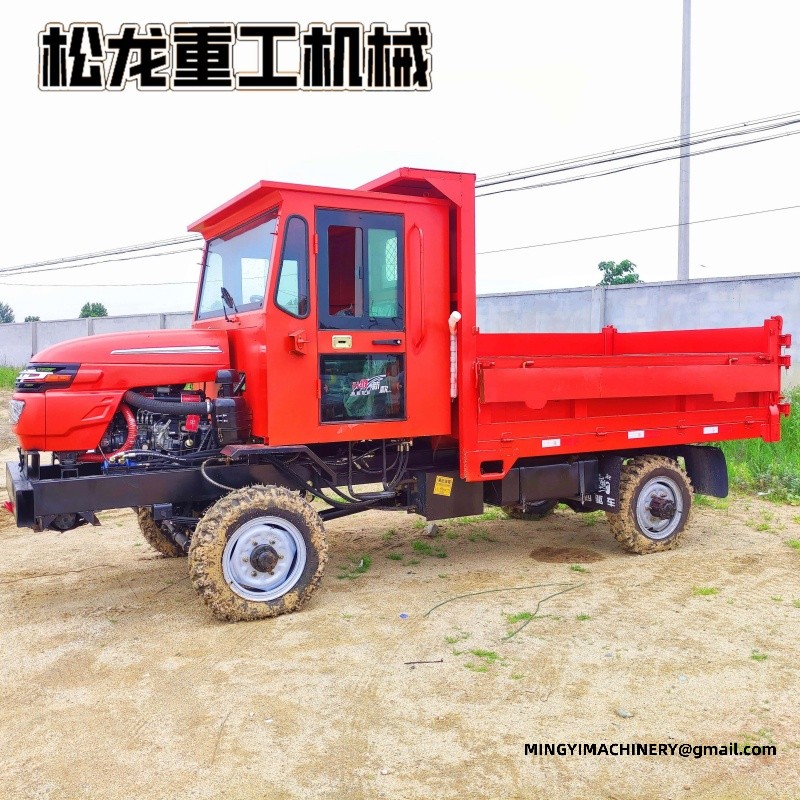
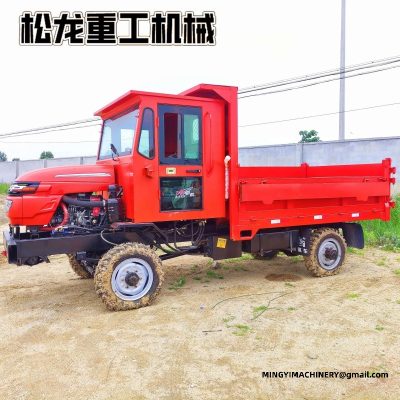
An off-road dumper lives or dies by its driveline, because the ground it crosses is the whole reason it exists. A road machine can be chosen on power and size; a dumper has to be chosen on what its axles, gearing and tyres do when the surface turns soft, rocky or loose. This page sorts the question by terrain. It reads the full-time four-wheel drive, the crawler gear, the front axle clutch and the 212 and 130 axles against the kinds of ground they are built for, so a buyer can pick a configuration from the route rather than from a photograph.
The first and most useful question about any dumper is what the ground is like for most of the year, because every downstream choice hangs on it. Soft ground punishes a machine that cannot keep all its wheels driving; rocky ground punishes a driveline that is not strong enough; loose, shifting fill punishes a machine that cannot hold a slow, steady crawl. The route is the specification, and the machine is the answer to it. A buyer who can describe the surface in three words has already done most of the sizing, because the machine that follows is nothing more than that description made solid.
Every configuration in this range uses a full-time gearbox with four-wheel drive, which is the deliberate choice for a machine whose ground cannot be trusted. With both axles driving all the time, the machine keeps moving when one wheel loses grip, because the others continue to pull. On a dumper the alternative, a wheel that spins while the machine digs in, is exactly the failure a full-time arrangement exists to prevent. This is not an option to be weighed; it is the foundation the rest of the machine is built on, and every other choice is made on top of it.
High and low range with a crawler gear is carried by every configuration, and it is the feature that lets a loaded dumper move at a walking pace up a grade or across broken ground without stalling or wheel-spin. Speed is the enemy of grip on a steep or loose surface, and the crawler gear removes speed from the equation while keeping the engine in its working range. A driver who can hold that crawl all the way up a slope does more with modest power than a driver who has to take a run at it.
Three of the four configurations carry a front axle clutch. It lets the front axle freewheel when the machine crosses a firm, graded section, so the driveline is not wound tight where four-wheel drive is not needed, and it re-engages drive where the ground softens again. The point is not to turn the dumper into a two-wheel-drive machine but to spare the transmission on the mixed route that has hard stretches between the soft ones. A buyer whose ground is soft from end to end simply keeps drive engaged throughout, and never notices the clutch is there.
It helps to sort the route into four rough classes and match each to the machine. Graded and drained ground is the easiest and needs the least from the driveline. Loose fill wants grip and a steady crawl. Rocky ground wants axle strength and a careful line. Soft or muddy ground wants the full-time drive plus tyres that can reach down to something firm. Most sites are a mix, and the configuration should be read against the worst patch on the route, not the best, because the machine is only as capable as the worst ground it is asked to cross.
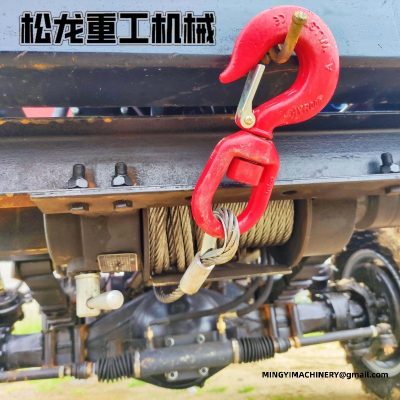
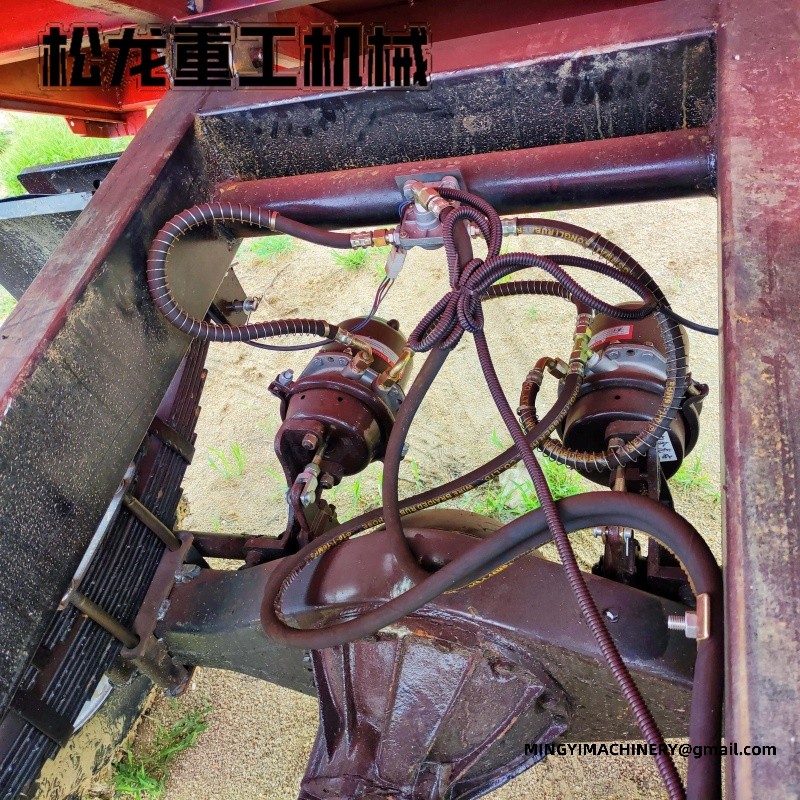
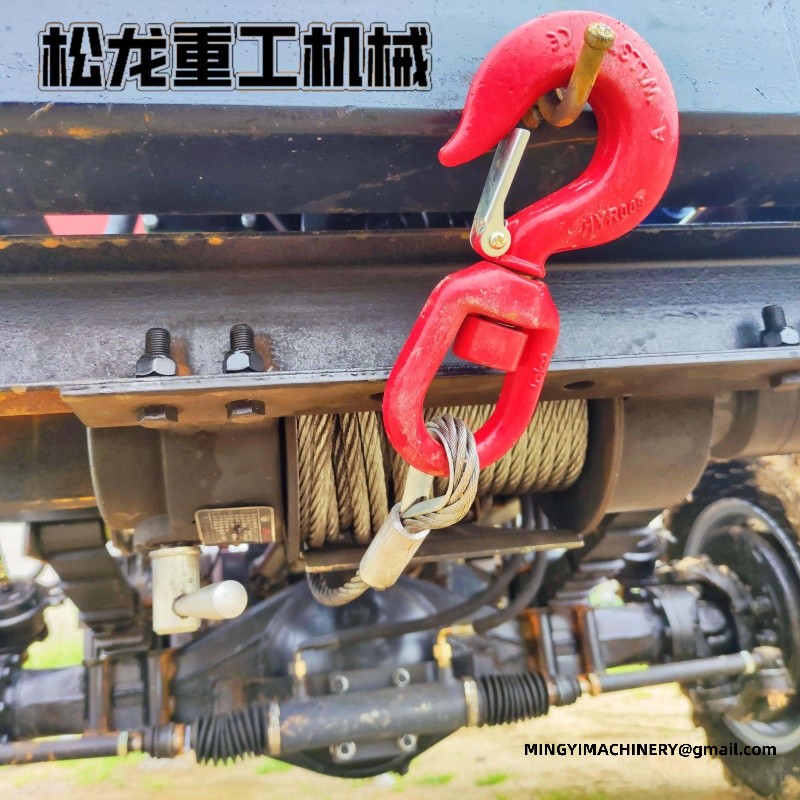
The Model 212 front axle and Model 130 rear axle carry the whole range, chosen because they are the size that survives the kind of twisting and shock an off-road body delivers. On rocky or rutted ground the axles take a pounding that a road axle never sees, and the reinforced 60 x 140 mm square tube frame is there to keep the whole assembly straight under it. The buyer who expects to cross rock or deep ruts is the one who benefits most from a driveline and frame chosen for that work from the start.
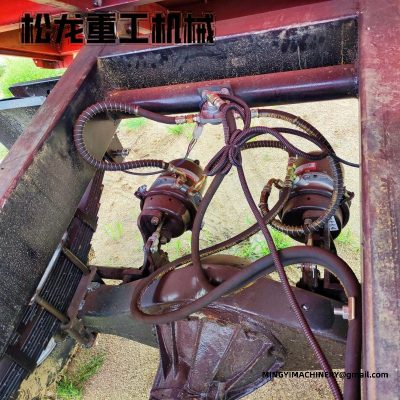
Oil brakes are fitted across this range and are matched to a machine whose speeds are low but whose loads are full. The brake that matters on a dumper is the one that holds a loaded body on a descent, not the one that stops a fast road speed, and oil brakes are the right tool for that repeated, loaded, low-speed duty. A buyer should think about the steepest slope the machine will descend with a full body, because that is the point where the brake specification is genuinely being tested, load after load, on the same stretch of ground.
The range runs on four 700-16 mountain tyres, one set at each corner of the machine. The mountain pattern is the part that does the work in mud and loose fill, clearing the tread and cutting down to whatever is firm underneath. Four tyres on a dumper are enough because the machine is compact and the body, at 2.2 m long by 1.5 m wide and 0.45 m high, keeps the load low and central. Keeping the weight over the driven wheels is what lets a four-tyre machine do the work that a bigger footprint would only disguise.
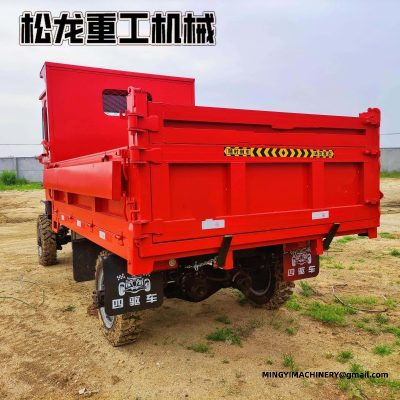
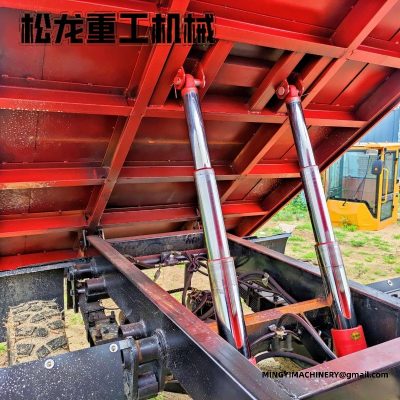
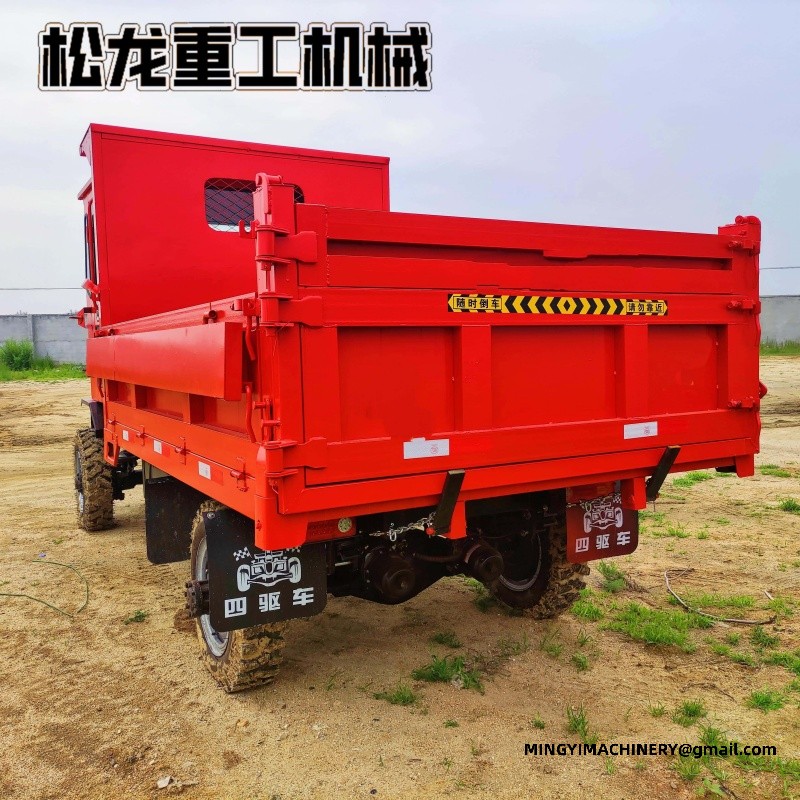
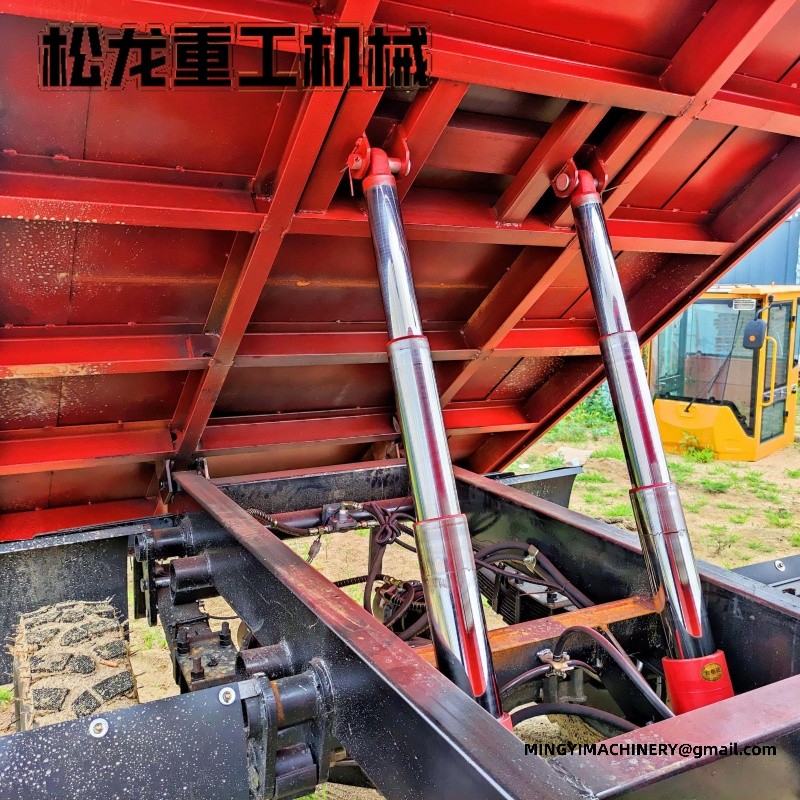
The rear body measures 2.2 m long, 1.5 m wide and 0.45 m high on every configuration, a size that keeps the centre of gravity low and the machine stable when it is tipping on uneven ground. A low, compact body is a safety feature on a slope, because a machine that tips from a high body on soft ground can settle or lean in ways a lower body will not. The self-dumping tailgate finishes the job cleanly, and the twin hydraulic rams lift a full body without twisting it as the load shifts to one side.
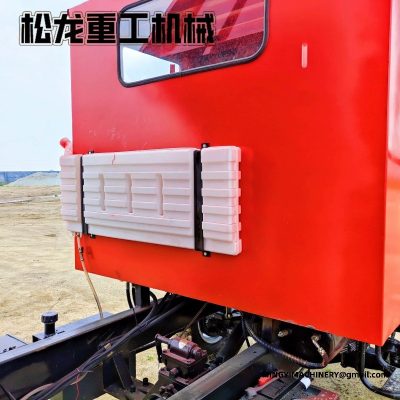
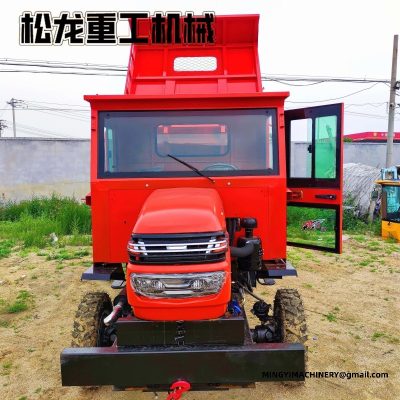
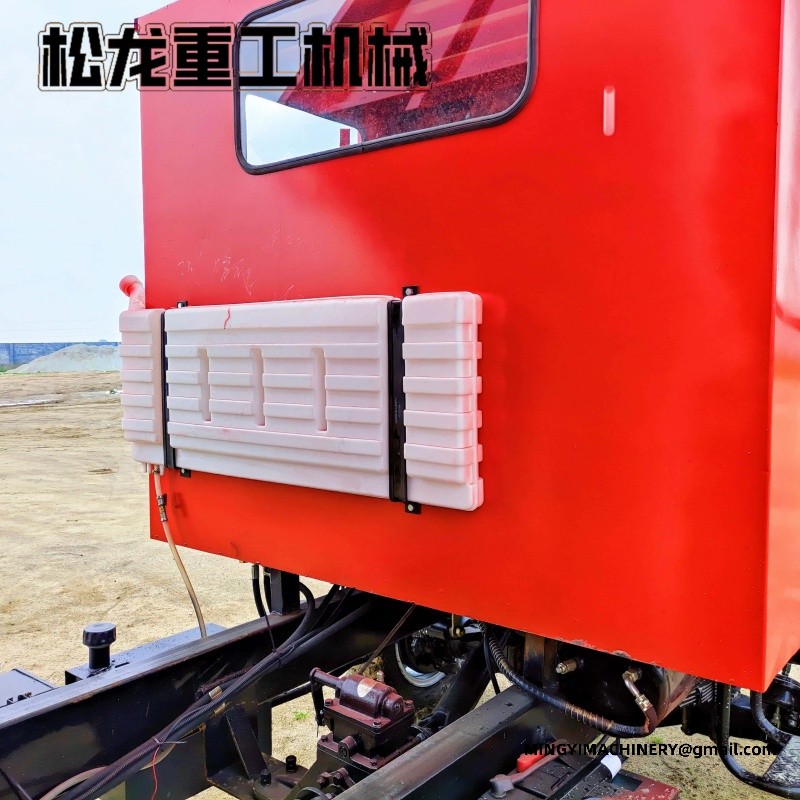
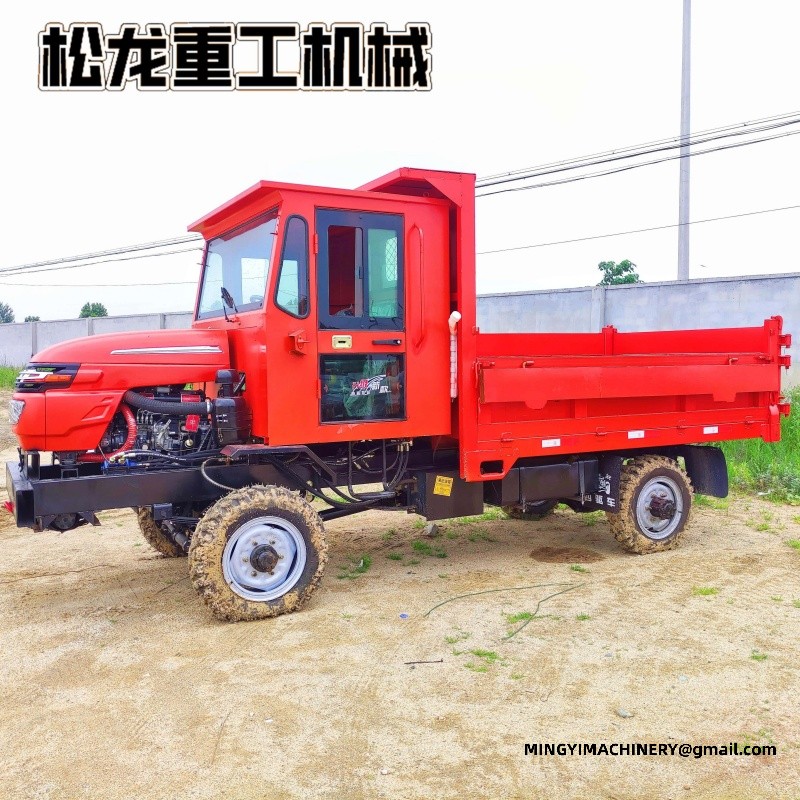
The fully enclosed cab on three configurations and the simple cab on the fourth reflect how long the driver stays in the machine. On broken ground the driver's line of sight to the wheels and the body edges is part of the machine's capability, because a dumper is steered by eye as much as by the hydraulic power steering. The two-person comfort seat keeps a second worker or a spotter beside the driver where the ground is bad enough to need one, and that second pair of eyes is often the difference on a blind edge.
The engines run from the single-cylinder 25 hp, 28 hp and 32 hp machines to the two-cylinder 38 hp, and the deciding factor is gradient more than load. On flat or gently sloping ground the single-cylinder machines are enough, because the full-time drive and the crawler gear already do much of the work. Where the route climbs, the two-cylinder 38 hp engine is the one that holds the loaded crawl without the driver constantly working the throttle. State the steepest grade with the enquiry and the engine choice answers itself, because the climb is the only number the engine is really being asked to meet.
Twin hydraulic rams lift the body from both sides, which matters more off-road than anywhere else because a dumper rarely tips on level ground. A body raised on a single ram can twist when the machine sits across a slope or when the load has shifted to one side; two rams share the lift and keep the body coming up straight. Combined with the self-dumping tailgate, the twin rams let the load leave early and evenly, so the machine is never balanced on a high, half-empty body in the most dangerous part of the cycle.
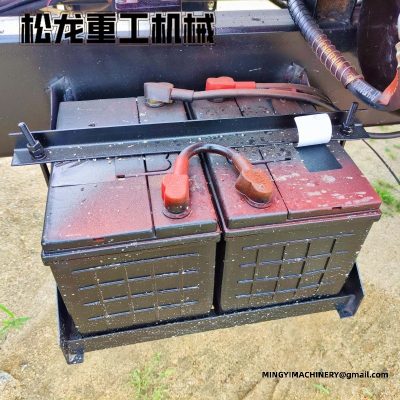
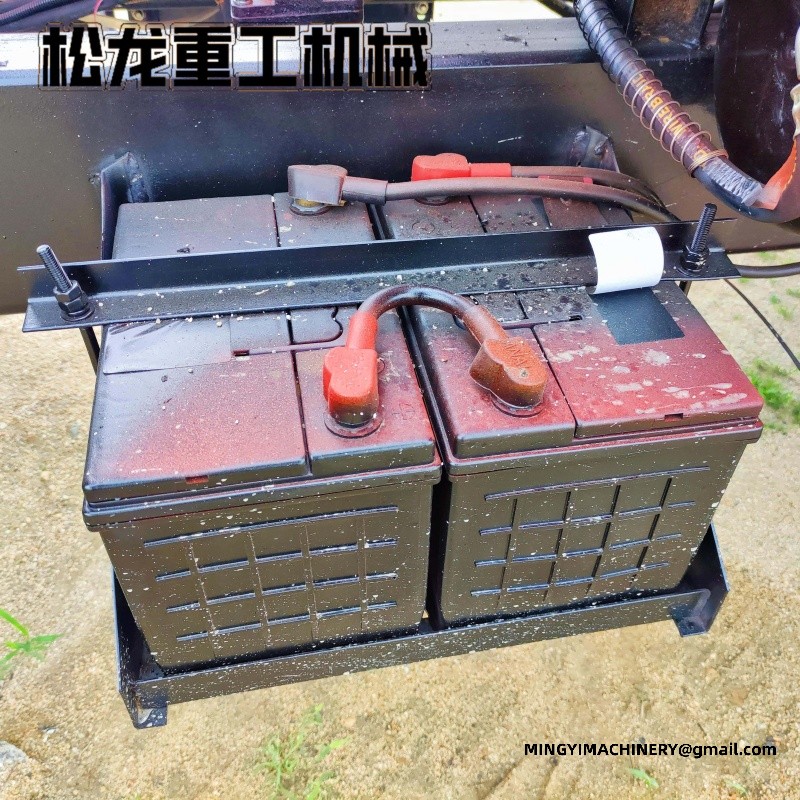
Twin-battery electric start is fitted to every configuration, and on a dumper the value is about where the machine sleeps. A machine parked out on the site, cold and dusty, has to fire reliably when the shift begins, because the day does not start until it does. The second battery is the reserve that covers a drained first battery or a cold morning, and it is the kind of provision that asks for no attention in the daily running but removes the single most common reason a dumper sits still at the gate, which is the one failure that a shift cannot work around.
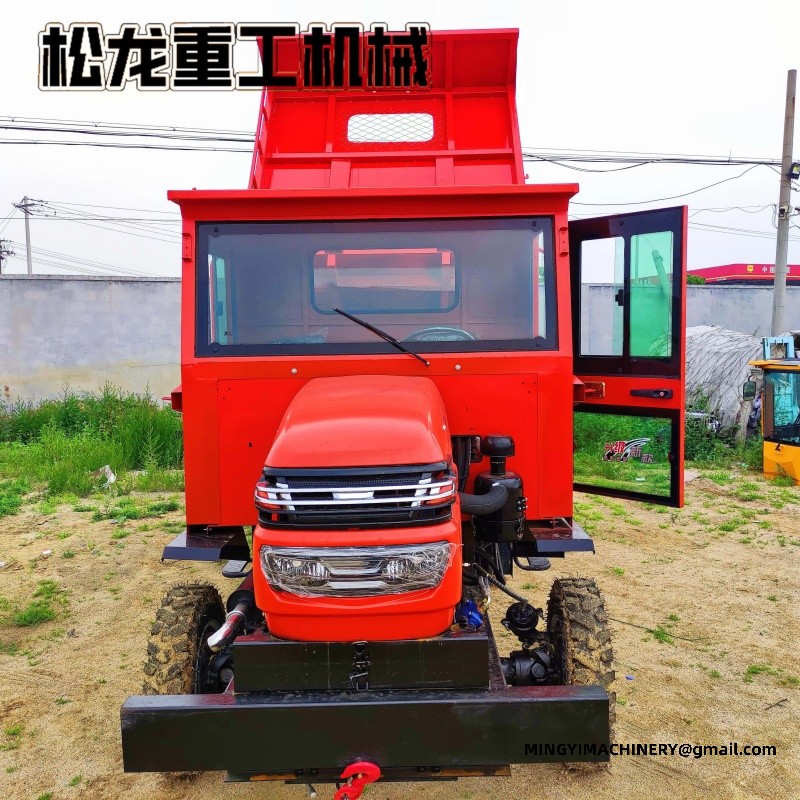
The round-nose bonnet and the square-nose bonnet appear across the configurations, and the choice is mostly about clearance and appearance. On a dumper the nose is the first part of the machine into a tight track or up against a loading face, so a buyer working confined ground should settle the shape that suits it. It is a minor point next to the driveline, but it is exactly the kind of detail that is quick to confirm at order stage and awkward to live with afterwards, when the machine has to squeeze into the same place every day.
The whole range sits on the same driveline foundation and differs only where the ground differs. To pick between the configurations a buyer needs to describe the route: soft or firm, flat or climbing, and how long the machine runs each week. Those three facts sort the engine, the cab and the nose without any guesswork, and they let the recommendation that comes back be checked against the ground the buyer already knows. A dumper is a machine for a particular place, and it is chosen by describing that place, in the same words the driver would use to warn someone else about it.
| # | 13.Upgraded | 4.Upgraded | 7.Upgraded | 9.Standard |
|---|---|---|---|---|
| 1 | Two-cylinder diesel engine, 38 hp | Single-cylinder diesel engine, 25 hp | Single-cylinder diesel engine, 28 hp | Single-cylinder diesel engine, 32 hp |
| 2 | Full-time gearbox with four-wheel drive | Full-time gearbox with four-wheel drive | Full-time gearbox with four-wheel drive | Full-time gearbox with four-wheel drive |
| 3 | High/low range with crawler gear | High/low range with crawler gear | High/low range with crawler gear | High/low range with crawler gear |
| 4 | Front axle clutch | Front axle clutch | Front axle clutch | Simple cab |
| 5 | Fully enclosed cab | Fully enclosed cab | Fully enclosed cab | Oil brakes |
| 6 | Oil brakes | Oil brakes | Oil brakes | Four 700-16 mountain tyres |
| 7 | Four 700-16 mountain tyres | Four 700-16 mountain tyres | Four 700-16 mountain tyres | Front axle 212 |
| 8 | Front axle 212 | Front axle 212 | Front axle 212 | Rear axle 130 |
| 9 | Rear axle 130 | Rear axle 130 | Rear axle 130 | Reinforced 60 x 140 mm square tube frame |
| 10 | Reinforced 60 x 140 mm square tube frame | Reinforced 60 x 140 mm square tube frame | Reinforced 60 x 140 mm square tube frame | Rear body 2.2 m long x 1.5 m wide x 0.45 m high |
| 11 | Rear body 2.2 m long x 1.5 m wide x 0.45 m high | Rear body 2.2 m long x 1.5 m wide x 0.45 m high | Rear body 2.2 m long x 1.5 m wide x 0.45 m high | Tailgate with self-dumping function |
| 12 | Tailgate with self-dumping function | Tailgate with self-dumping function | Tailgate with self-dumping function | Hydraulic power steering |
| 13 | Hydraulic power steering | Hydraulic power steering | Hydraulic power steering | Twin hydraulic rams |
| 14 | Twin hydraulic rams | Twin hydraulic rams | Twin hydraulic rams | Two-person comfort seat |
| 15 | Two-person comfort seat | Two-person comfort seat | Two-person comfort seat | Twin-battery electric start |
| 16 | Twin-battery electric start | Twin-battery electric start | Twin-battery electric start | Square-nose bonnet |
| 17 | Round-nose bonnet | Square-nose bonnet | Square-nose bonnet | — |
For a specification discussion or a build sheet for this off-road dumper, contact mingyimachinery@gmail.com or reach us on LINE (ID: mingyicn).









