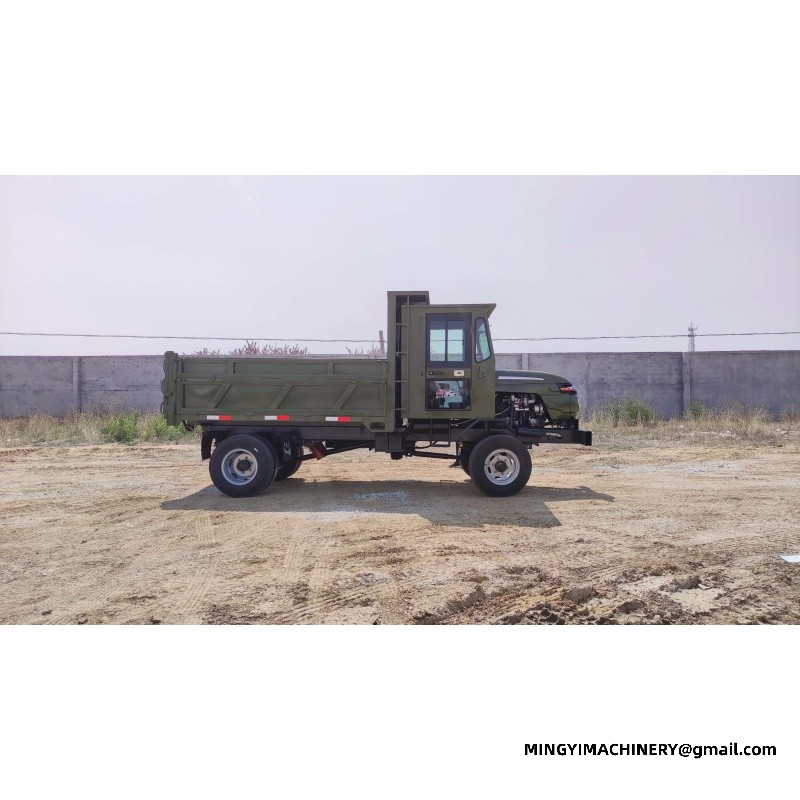
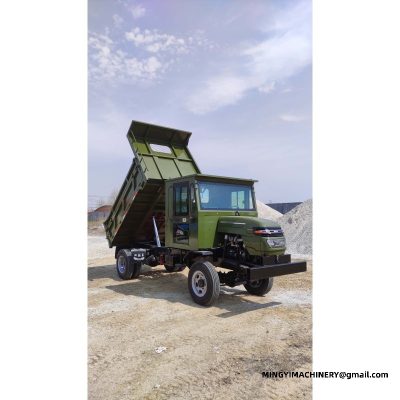
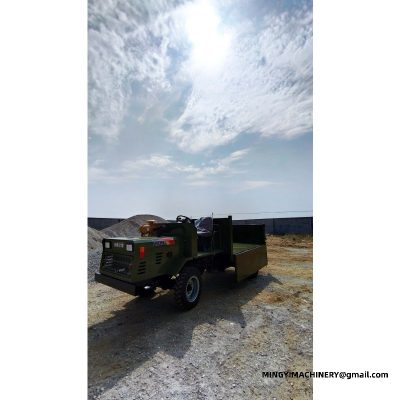
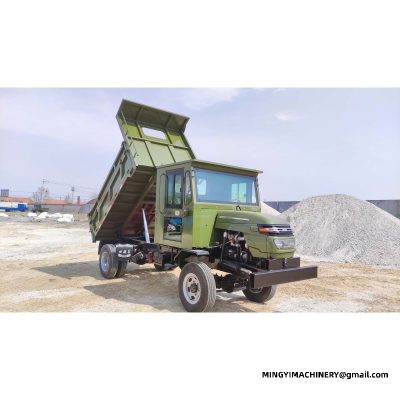
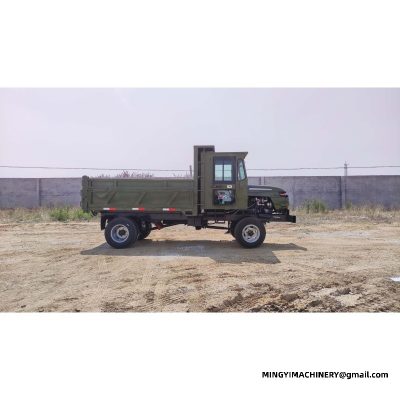
Model MY-4x4-4T
You have just taken delivery of a Mingyi 4x4 off-road dumper, and the thirty days after it lands decide how the next ten years will go. Most early failures are not built into the machine; they are invited in by the first month of use, when bolts settle, fluids bed down and the driver learns where everything lives. This page is written as a working owner's guide rather than a sales leaflet: a daily walk-around you can do in ten minutes, a running-in list for the first month, and the checks that turn a new dumper into a dependable one.
Before the first load goes on, spend half an hour learning the machine with the engine off. Walk around it once and put a hand on the parts this guide will ask about every day: the bonnet catch and the round-nose or square-nose bonnet, the two hydraulic rams beside the body, the tailgate latch, the leaf springs, the battery box and the air cut-off or oil-brake reservoir. Open nothing yet. The point of this first hour is to learn where each item sits so that the daily check becomes a habit you can run through in the dark, rather than a search every morning.
Every shift starts with the same circuit, always in the same order. Begin at the front, check the bonnet is latched and the radiator face is clear, then move down the right side: front tyre, spring, brake line, ram mounting, rear tyre, tailgate. Cross the back and check the tailgate hinge and latch, then come up the left side the same way. Look for three things at each point: a wet patch that was not there yesterday, a fastener that has moved, and a part that has changed shape. Anything you notice, note it before starting the engine, because the note is what keeps a small fault small.
With the machine still cold, lift the bonnet and read the oil before the day's work stirs it around. The dipstick should show oil between its marks, and the colour should be dark amber rather than black or milky; milky oil means water is getting in, and it is the one sign that should stop the shift before it starts. Check the coolant level at the same time, and look at the fuel filter bowl for water. On the two-cylinder 38 hp machine these checks are a two-minute job; on the four-cylinder 4105 turbocharged engine there is simply a little more of everything to look at.
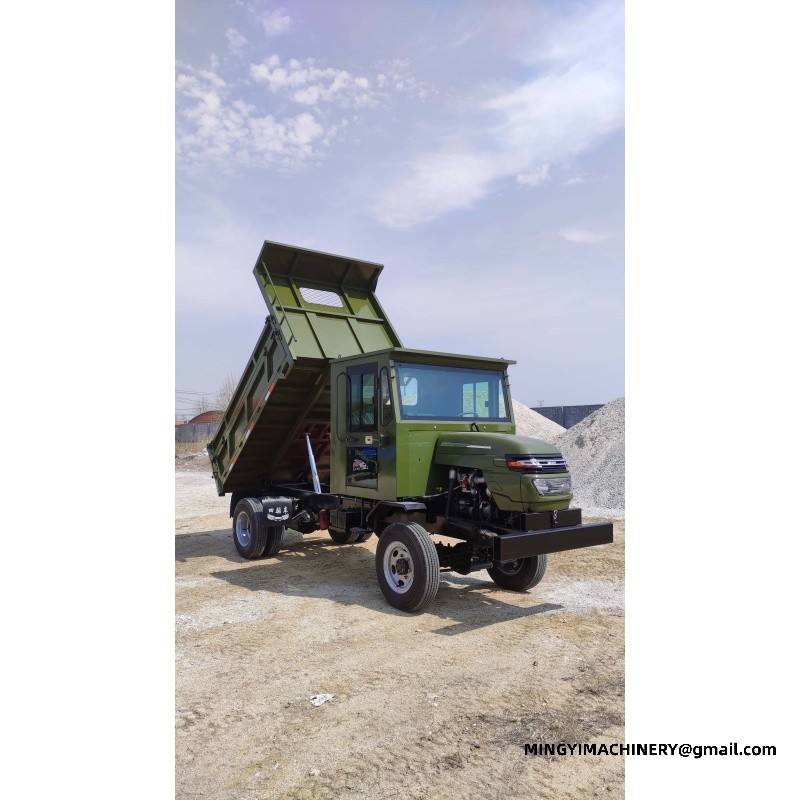
Three fluids matter on a dumper and none of them should be left to guesswork. Engine oil lives on the dipstick under the bonnet; hydraulic oil for the tipping circuit and the power steering sits in the reservoir beside the rams and should be checked with the body down and the engine off; and the brake fluid on an oil-brake machine or the air pressure on an air cut-off machine has its own gauge or sight glass. Learn where each lives on your specific model, because a machine that takes 700-16 tyres and a Model 212 front axle on one build can carry a different brake system from a near-identical neighbour.
The 700-16 mountain tyres on the 14.Luxury and the 825R16 steel-belted radials on the 22.Luxury both earn their keep through the patch of rubber that meets the ground, and that patch depends on pressure. Check all six, or all four, cold, before the day's heat and load change the reading. A tyre a few pounds down flexes more, runs hotter and wears its shoulders; one over pressure bounces and loses grip. Use the same gauge every time, keep a note of the reading, and a slow leak that would otherwise go unnoticed shows up as a number that falls a little every morning.
Brakes are the one system where a change in feel is a warning you should never get used to. On the air cut-off machines, the pedal should build a firm reserve of air within the first minute of running and the pressure should hold when the engine stops; on the oil-brake models, the pedal should be firm and the level in the reservoir steady. A pedal that creeps down, a machine that pulls to one side, or a hiss of air that will not stop are all reasons to park the machine and look, not to carry on. Brakes that fade on a loaded descent do not give a second chance.
The twin hydraulic rams are what turn a body full of material into an empty one, and the first lifts of a new machine deserve watching rather than just operating. Raise the body slowly, listen for the pump labouring, and watch both rams rise together; one ram moving ahead of the other means air in the circuit or a load sat to one side. Lower the body gently to the stops the first few times, because slamming a new body down shocks the mountings while they are still bedding in. The self-dumping tailgate should start the load moving before the body is fully up.
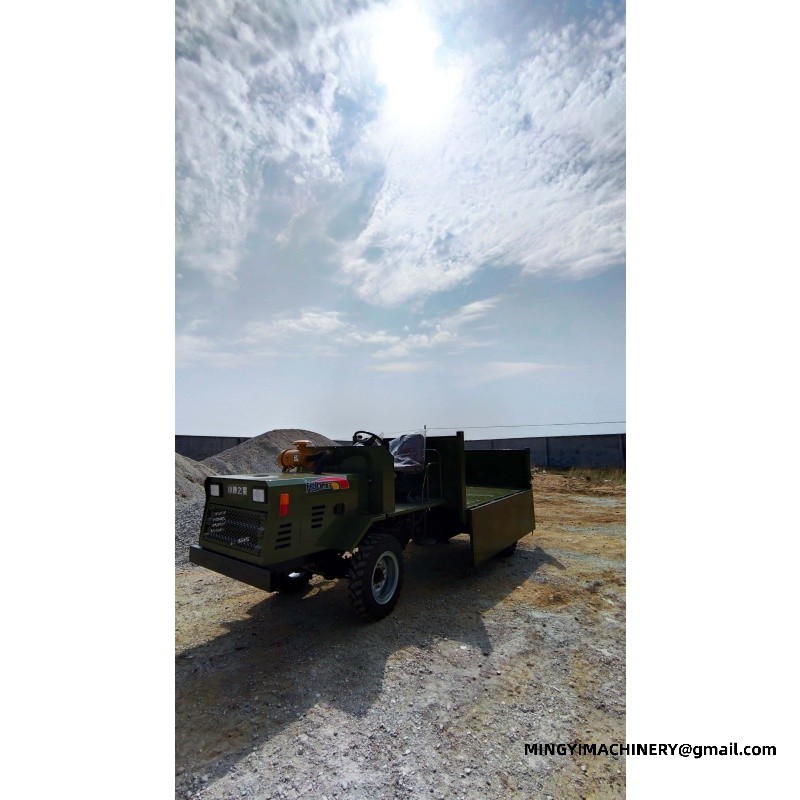
Hydraulic power steering should leave the wheel light and free of slack, and the two-person comfort seat should keep the driver and a passenger planted rather than bouncing against the cab. Spend a moment at the start of the week checking the seat mountings and the steering linkage for play, because a loose seat bolt or a worn drag link is felt first as a vague machine and only later as a fault. The cab itself, whether the enclosed cab of the 14.Luxury or the fully enclosed cab of the 22.Luxury, should close squarely, with the wipers and the door latch in good order.
Greasing is the single cheapest habit that keeps a dumper young, and it only works if it happens on a fixed day rather than when someone remembers. Pick a day, write it down, and grease the kingpins, the prop shaft joints, the spring shackles and the ram pivots in the same order every week. In the wet season, halve the interval; water thins grease and grit grinds it away. A machine that is greased weekly will still steer lightly and tip smoothly at five thousand hours, where one that is greased occasionally will feel loose long before it fails.
The first month is a running-in period, and treating it as one is the cheapest decision an owner makes. Keep the loads moderate for the first stretch rather than testing the machine on its first day, vary the engine speed instead of holding it flat, and avoid the steepest and roughest ground until the machine has loosened up. Cycle the tipping system gently and lower the body under control. The idea is not to coddle the dumper but to let the surfaces that run together wear into each other cleanly, so that the clearances stay tight and the first service drains out metal rather than a problem.
The first service matters more than any service after it, because it is when the wear metal from running-in is drained away and the fasteners that settle under load are taken up again. Oil and both filters, the hydraulic oil if it has darkened, and a re-torque of the body, ram and spring mountings belong on the list. Go over every bolt you can reach and check the brake adjustment and the clutch travel. Skipping this service saves nothing; the bolt left loose and the oil left dirty simply fail later, further from the workshop and at a worse moment.
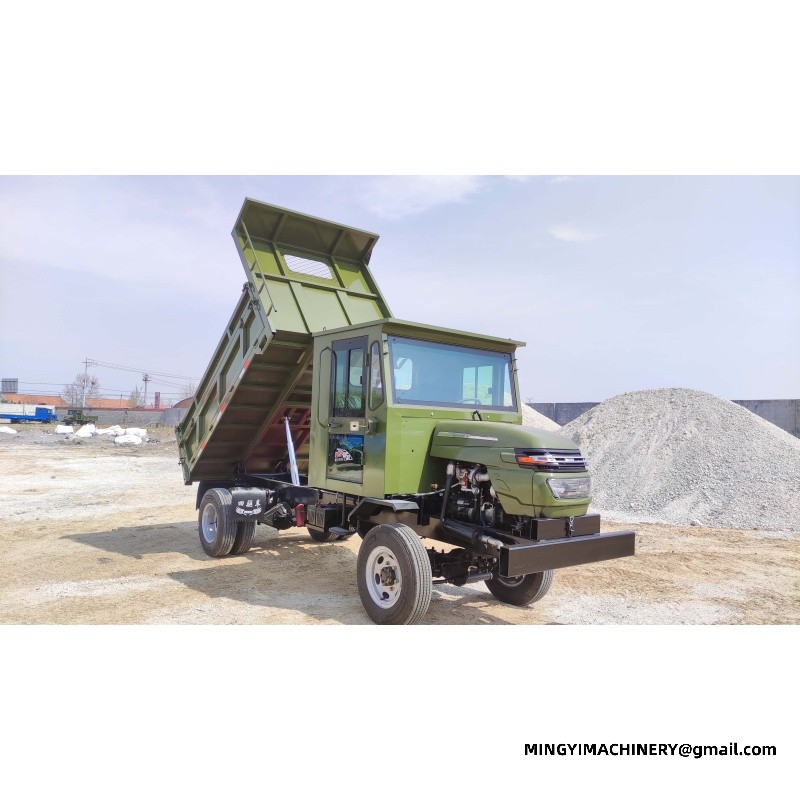
Keep a notebook, or a note on a phone, with three columns: the date, the hour reading, and anything you saw, heard or felt. The value is not the individual lines but the pattern they form, because a fault that returns, a tyre that keeps losing pressure, or a brake that needs adjusting twice in a month all stand out as trends when they are written down and stay hidden when they are not. The hour reading is the anchor: service intervals are counted in hours, and a notebook that records them is the difference between servicing by schedule and servicing by surprise.
A dumper is sized by its body and its frame, and the first haul is the moment to learn what yours wants rather than to push it. The 2.2 m body on the 14.Luxury and the 3.0 m body on the 22.Luxury carry different volumes, but both should be loaded evenly across the floor rather than heaped to one side, because a side-heavy load twists the body as the rams lift. On a gradient, use the crawler gear and let the machine walk rather than fighting it in a higher gear, and remember that a loaded descent is where a dumper most needs its brakes to be right.
Most early problems are solved by the owner, but a few signs mean the machine should stop until someone who knows the model has looked. Metal in the engine oil, water in the hydraulic oil, a knock that follows engine speed, or a ram that will not hold the body up are not items to drive through. Mingyi supports owners after the sale, and a question answered over the phone or a video walk-around with the panels open usually identifies the cause faster than a guess. The rule is simple: if the machine is telling you something new, listen before the shift, not after the damage.
The end of the first month is the moment to turn the habits of this guide into a routine that will run itself. Fix the greasing day, fix the service intervals in hours, and put the filters and the spare parts for the first year on the shelf while the machine is still new, because a machine standing idle for want of a filter is the most avoidable loss in the fleet. The four configurations here cover different duties, but every one of them answers to the same truth: a dumper that is checked daily, greased weekly and serviced on its hours will still be earning long after a neglected one has been parked.
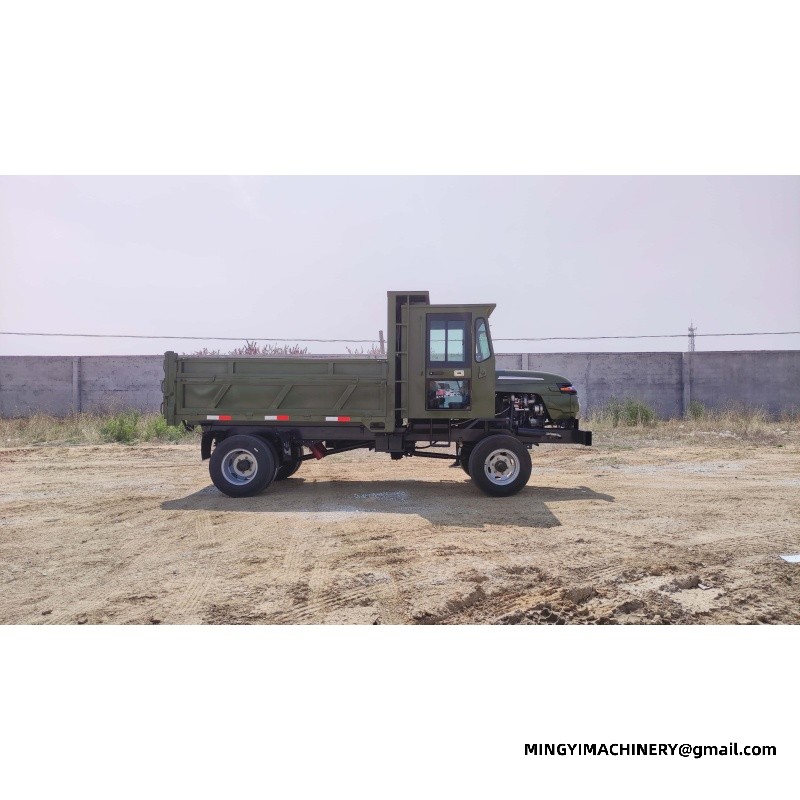
| # | 14.Luxury | 22.Luxury | 4.Upgraded | 7.Upgraded |
|---|---|---|---|---|
| 1 | Two-cylinder diesel engine, 38 hp | Four-cylinder 4105 turbocharged diesel engine | Single-cylinder diesel engine, 25 hp | Single-cylinder diesel engine, 28 hp |
| 2 | Part-time gearbox, selectable 2WD/4WD | Model 145 part-time gearbox with four-wheel drive | Full-time gearbox with four-wheel drive | Full-time gearbox with four-wheel drive |
| 3 | High/low range with crawler gear | High/low range with crawler gear | High/low range with crawler gear | High/low range with crawler gear |
| 4 | Enclosed cab | Fully enclosed cab | Front axle clutch | Front axle clutch |
| 5 | Six 700-16 mountain tyres | Six 825R16 steel-belted radial tyres | Fully enclosed cab | Fully enclosed cab |
| 6 | Model 212 front axle | Reinforced ISUZU-pattern front axle | Oil brakes | Oil brakes |
| 7 | Reinforced 130 rear axle | Reinforced 1080 rear axle | Four 700-16 mountain tyres | Four 700-16 mountain tyres |
| 8 | Air cut-off brakes | Air cut-off brakes | Front axle 212 | Front axle 212 |
| 9 | Reinforced 60 x 140 mm square tube frame | Reinforced 80 x 180 mm square tube frame | Rear axle 130 | Rear axle 130 |
| 10 | Rear body 2.2 m long x 1.5 m wide x 0.45 m high | Rear body 3.0 m long x 2.2 m wide x 0.45 m high | Reinforced 60 x 140 mm square tube frame | Reinforced 60 x 140 mm square tube frame |
| 11 | Tailgate with self-dumping function | Tailgate with self-dumping function | Rear body 2.2 m long x 1.5 m wide x 0.45 m high | Rear body 2.2 m long x 1.5 m wide x 0.45 m high |
| 12 | Side-opening rear body tailgate | Side-opening rear body tailgate with cab ladder | Tailgate with self-dumping function | Tailgate with self-dumping function |
| 13 | Hydraulic power steering | Hydraulic power steering | Hydraulic power steering | Hydraulic power steering |
| 14 | Twin hydraulic rams | Twin hydraulic rams | Twin hydraulic rams | Twin hydraulic rams |
| 15 | Heavy-duty leaf springs | Two-person comfort seat | Two-person comfort seat | Two-person comfort seat |
| 16 | Two-person comfort seat | Heavy-duty leaf springs | Twin-battery electric start | Twin-battery electric start |
| 17 | Twin-battery electric start | Twin-battery electric start | Square-nose bonnet | Square-nose bonnet |
| 18 | Round-nose bonnet | Square-nose bonnet | — | — |
For a specification discussion or a build sheet for this 4x4 off-road dumper, contact mingyimachinery@gmail.com or reach us on LINE (ID: mingyicn).









