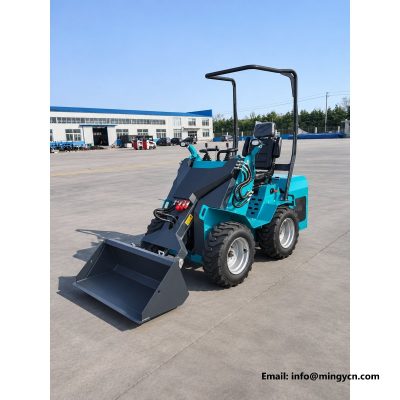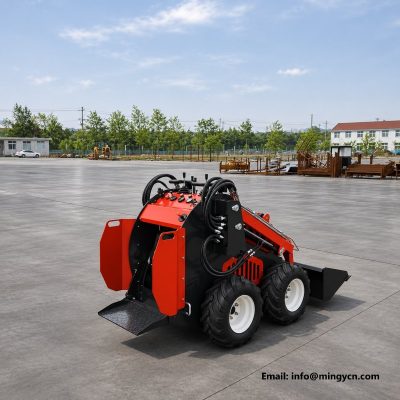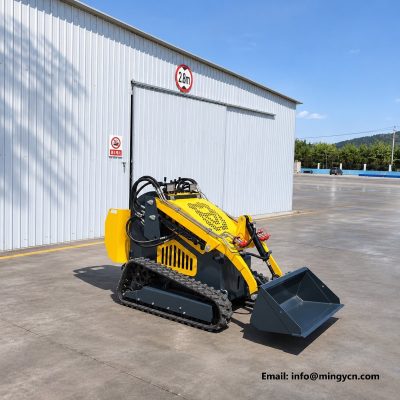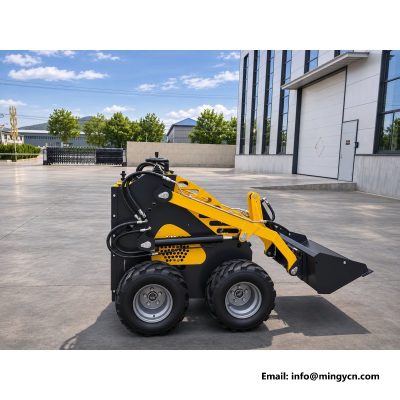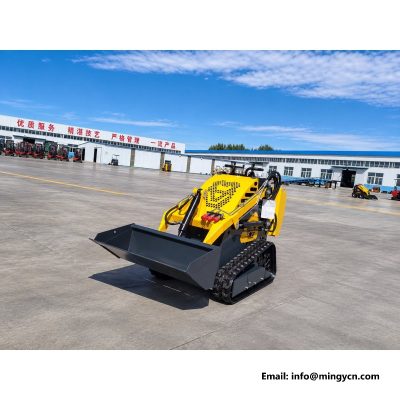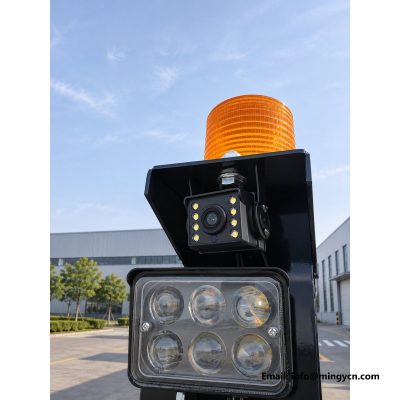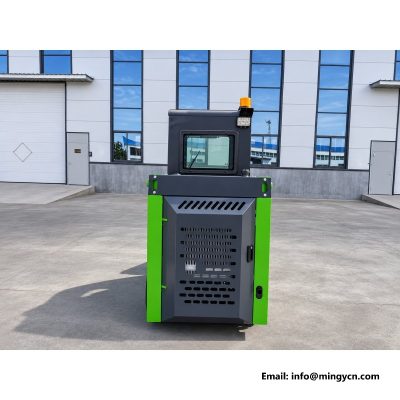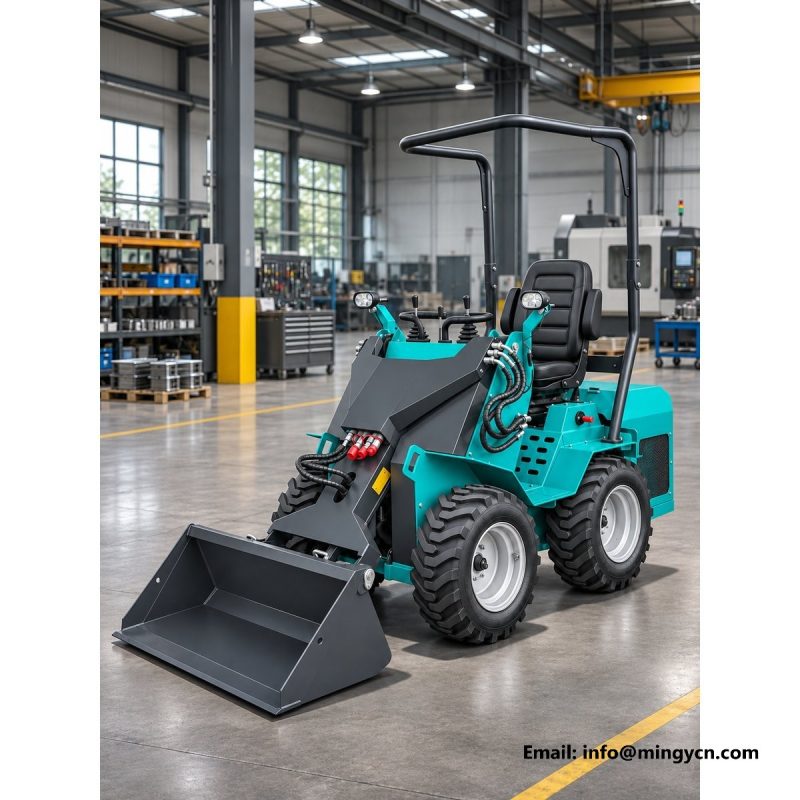
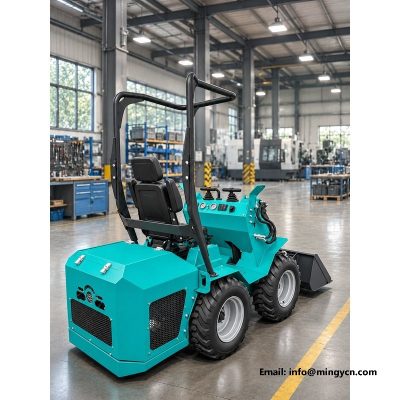
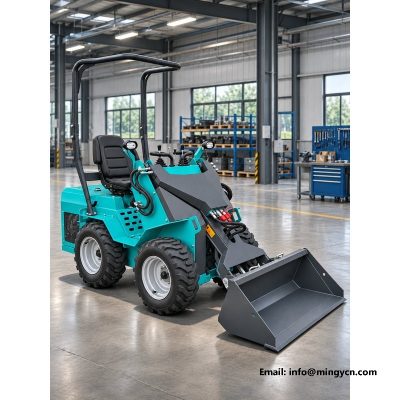
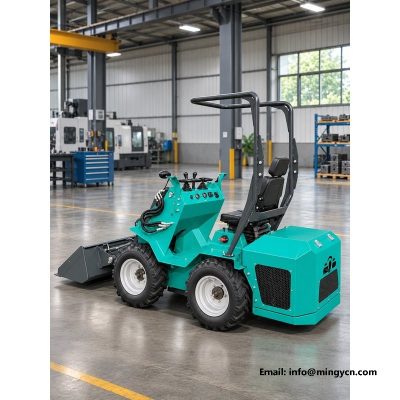
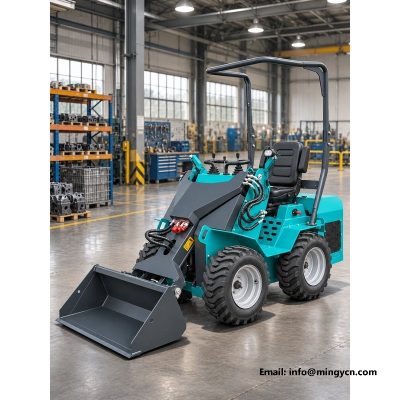
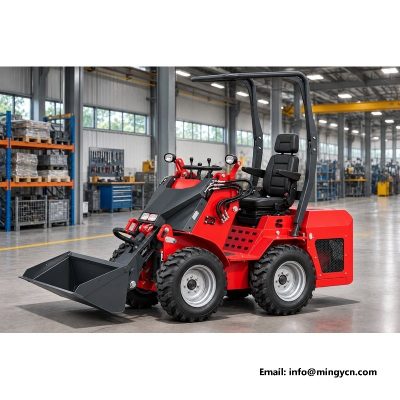
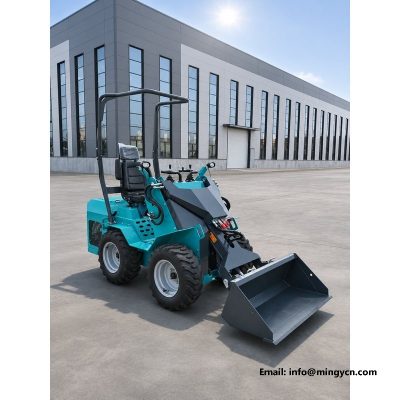
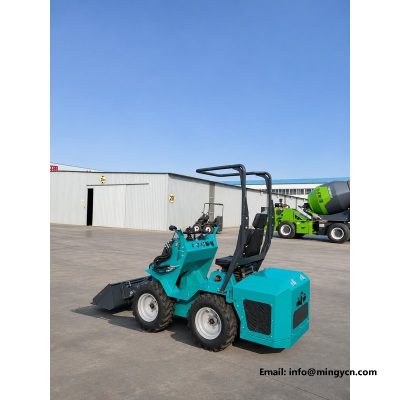
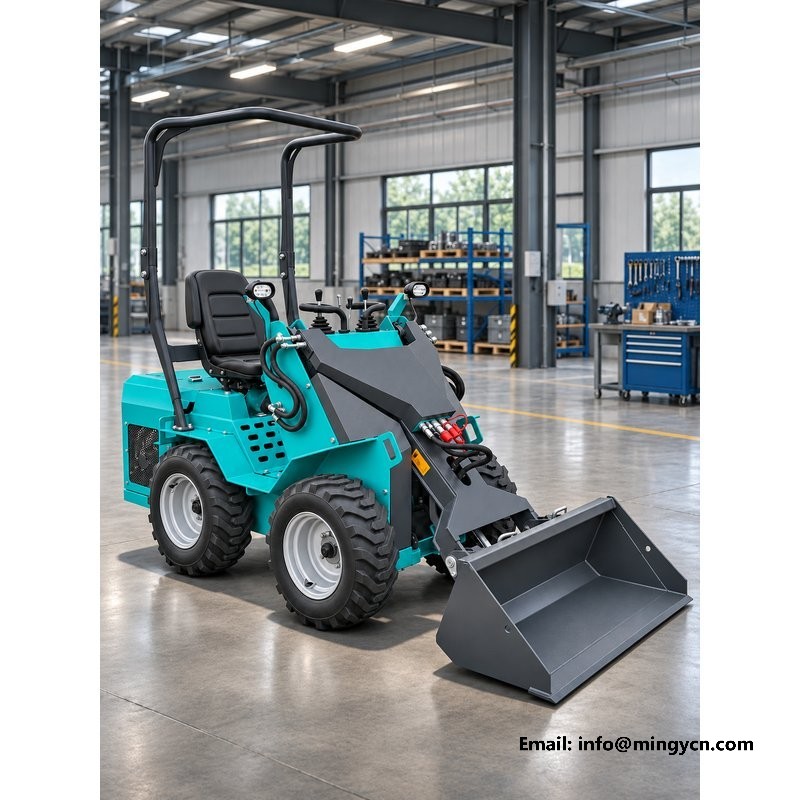
MY400 seated four-wheel-drive skid steer loader with a 0.06 m3 bucket.
The MY400 is a seated wheeled skid steer loader with four-wheel drive, a rated load of 300 kg and a standard bucket of 0.06 m3. It weighs 874 kg and travels at up to 6 km/h, rides on 23 x 8.5-12 tyres, and completes a full lift, lower and dump cycle in nine seconds. Where a tracked machine is chosen for ground protection, this one is chosen for speed across firm surfaces: yards, barn floors, concrete aprons and hard standing, where wheels roll faster and cost less to replace than tracks. Every figure on this page comes from the specification sheet for this model.
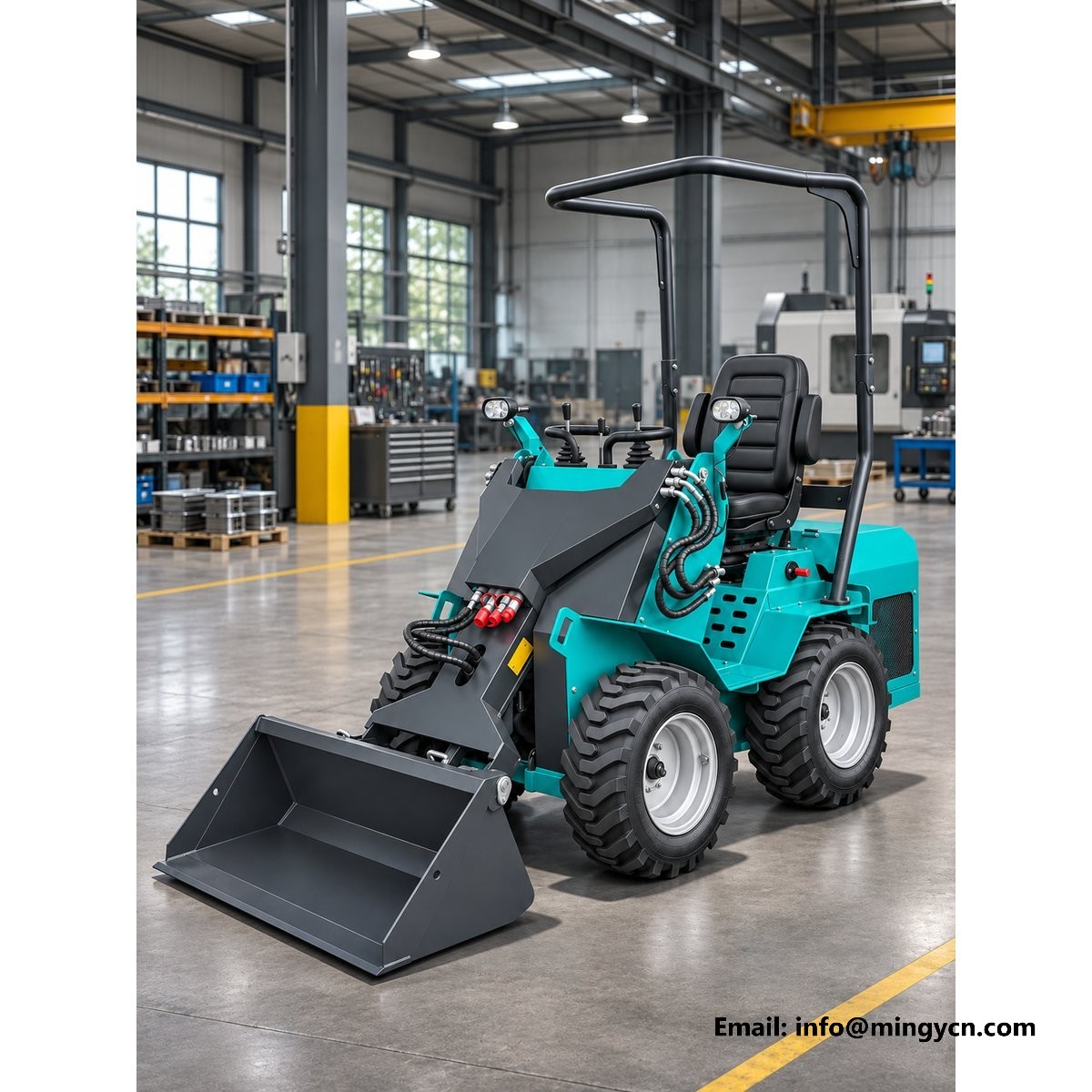
A wheeled skid steer is faster across firm ground, cheaper to run on tyres and simpler to maintain than a tracked machine of the same size. A tracked machine protects lawns and soft ground and carries more load on the same footprint. The two are not interchangeable, and buyers who choose on price alone usually choose wrong. If the working surface is concrete, asphalt, packed gravel or a barn floor, wheels win on every count. If the surface is turf, mud or freshly graded soil, tracks win and the tyre savings disappear in surface damage.
All four wheels are driven, and steering is achieved by driving the left and right sides at different speeds, which is what makes a skid steer turn inside its own length. That geometry is the reason the machine can work in a yard where a conventional loader cannot turn. It is also the reason tyres wear quickly on abrasive surfaces, particularly during tight turns on concrete. Operators who need long tyre life learn to make three-point turns rather than pivoting on the spot, and buyers who work mainly on concrete should budget for tyres as a consumable rather than a wear part.
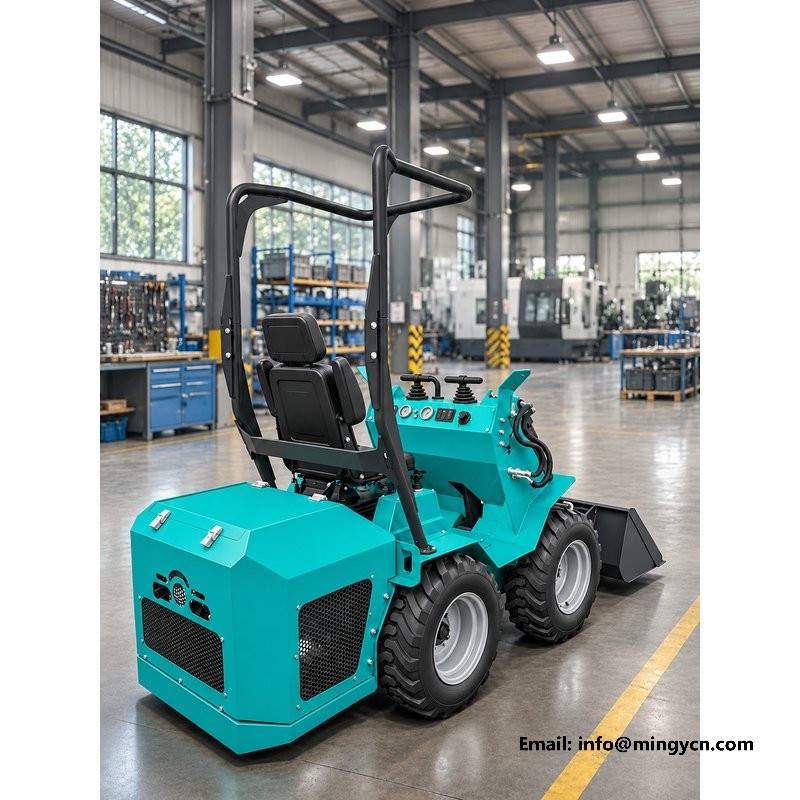
The rated operating load is 300 kg and the maximum load is 400 kg, with a standard bucket of 0.06 m3. In practice that covers a pallet of block, a scoop of aggregate, a load of green waste, or a bundle of fence posts. It does not cover a bulk bag of sand at full weight, and buyers who need that should be looking at the next size class. The lift, lower and dump cycle takes nine seconds, which sets the real production rate: on a repetitive loading job, cycle time matters more than bucket capacity, and a nine-second cycle is competitive for this class.
Maximum operating height is 2,560 mm, height to the bucket pin is 1,970 mm, and overall height is 1,950 mm. Dump height is 1,650 mm at a dump reach of 650 mm, which is enough to clear a trailer side or a low skip but not a high-sided truck. Overall length is 2,130 mm without an attachment and 2,600 mm with the standard bucket, and the bucket rolls back 20 degrees at ground level and 120 degrees at full height. Those two rollback figures decide how well the machine carries a loose load without spilling it on the way.
| Model | MY400 |
| Configuration | Seated wheeled skid steer loader, four-wheel drive |
| Engine options | Runtong R420D, Briggs & Stratton X2100, Kepu 192 |
| Rated power | 13.5 hp (R420D and X2100), 10.2 kW (Kepu 192) |
| Rated engine speed | 3,600 rpm (R420D and X2100), 3,000 / 2,500 rpm (Kepu 192) |
| Displacement | 420 cc |
| Cylinders | 1, naturally aspirated |
| Emission standard | EU Stage V / EPA |
| Rated operating capacity | 300 kg |
| Maximum load | 400 kg |
| Bucket capacity | 0.06 m3 |
| Operating weight | 874 kg |
| Travel speed | 0-6 km/h |
| Lift, lower and dump cycle | 9 s |
| Maximum operating height | 2,560 mm |
| Height to bucket pin | 1,970 mm |
| Overall height | 1,950 mm |
| Dump height | 1,650 mm |
| Dump reach | 650 mm |
| Bucket rollback at ground | 20 degrees |
| Bucket rollback at maximum height | 120 degrees |
| Overall length without attachment | 2,130 mm |
| Overall length with standard bucket | 2,600 mm |
| Tyres | 23 x 8.5-12 |
| Fuel tank | 5 L |
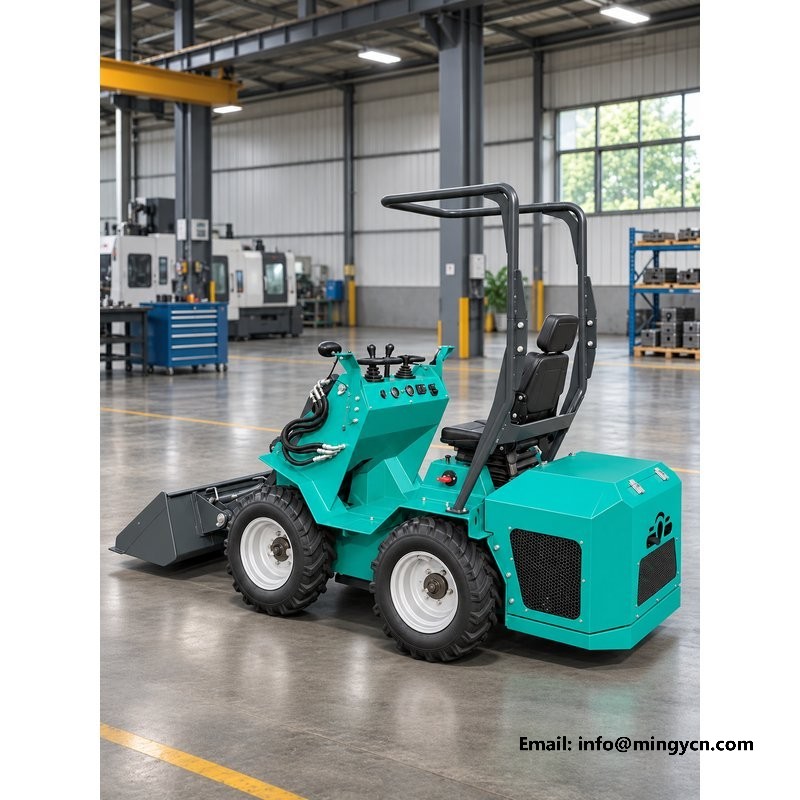
Three engines are offered. The Runtong R420D and the Briggs & Stratton X2100 both deliver 13.5 hp at 3,600 rpm, and the Kepu 192 delivers 10.2 kW. The R420D is the usual default in export markets where diesel parts are easy to find, while the X2100 is familiar to buyers who already run Briggs equipment. The emission standard is quoted as EU Stage V and EPA, which can only be confirmed against the specific engine ordered: put the engine model and the certificate in the purchase order, because it cannot be changed after the machine is built.
Farm yards, stables and poultry units, where the machine mucks out, feeds and moves pallets on concrete. Builders merchants and small depots, where it loads trailers and stacks materials. Landscapers working on surfaces that will not be damaged by tyres. And rental fleets, because a seated machine is easier for an unfamiliar operator than a stand-on platform and tyres are cheaper to replace than tracks. It is not the machine for turf in wet weather, for soft ground, or for high-sided truck loading, where a larger machine with more dump height is required.
Work every function and confirm that both sides drive evenly in forward and reverse. Check that the lift arms hold position under load without drift and that the bucket self-levels if the machine is so equipped. Inspect all four tyres for cuts and check the wheel nut torque. Look at the hydraulic fittings for weeping and confirm the reservoir level. Check the ROPS frame mounting bolts. Confirm the hour meter reading and photograph any defect before signing the delivery note.
Order forks, a four-in-one bucket or a grapple with the machine rather than afterwards, because a second shipment usually costs more than the attachment. Ask for the tyre size and the wheel rim specification so replacements can be sourced locally, and confirm the filter part numbers for engine oil, fuel and hydraulic oil. For a machine working in a dusty yard, order two air filters at the start rather than one.
Ordering and technical support
Email: sales@mingycn.com
LINE (ID): mingyicn
Tell us the trench width, ground conditions and attachments you need, and we will confirm the right configuration and shipping details.